ITR-1 (Sahaj) is India’s simplest income tax return form – and for FY 2025-26 (AY 2026-27) it just became useful to even more taxpayers. This guide covers who can file ITR-1, what changed this year, the documents you need, and a step-by-step walkthrough of filing it online before the 31 July 2026 deadline.
Watch: ITR-1 (Sahaj) Explained in 2 Minutes
Watch: File ITR-1 in 5 Minutes – Step by Step
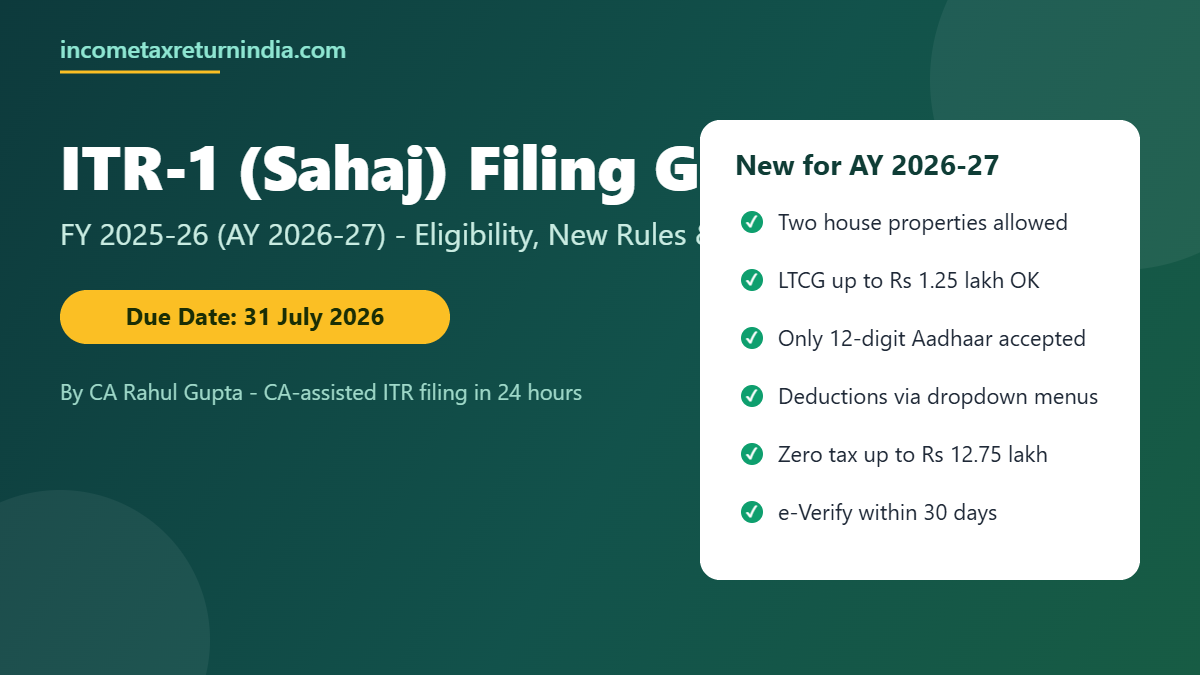
Quick answer: You can use ITR-1 for AY 2026-27 if you are a resident individual with income up to Rs 50 lakh from salary/pension, up to two house properties (new this year), other sources, and listed-equity LTCG up to Rs 1.25 lakh. Due date: 31 July 2026. Under the default new regime, salaried income up to Rs 12.75 lakh is effectively tax-free – but you still must file to stay compliant and claim your TDS refund.
What’s new in ITR-1 for AY 2026-27
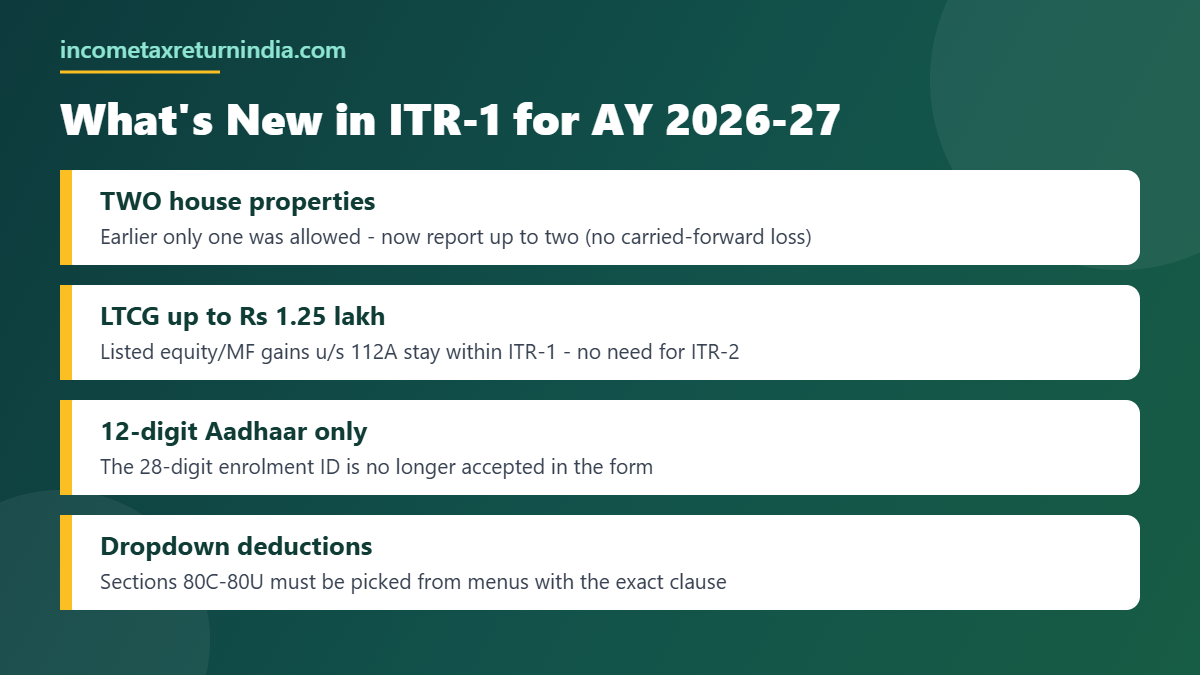
- Two house properties allowed – the biggest change. Until last year, owning a second house forced you into ITR-2. From AY 2026-27, ITR-1 accepts income from up to two house properties (as long as there is no brought-forward or carry-forward house property loss).
- Small equity LTCG stays in ITR-1 – long-term capital gains under Section 112A (listed shares, equity mutual funds) up to Rs 1.25 lakh can be reported in ITR-1 itself, with no losses to carry forward. Gains above that, or any other capital gains, still need ITR-2 – see our capital gains tax guide.
- Only 12-digit Aadhaar accepted – the 28-digit Aadhaar enrolment ID no longer works in the form.
- Deductions picked from dropdowns – Sections 80C to 80U must be selected from menus with the exact clause, so keep your proofs organised.
- New fields for Section 89A relief on foreign retirement accounts.
Who can use ITR-1 (Sahaj) for FY 2025-26?
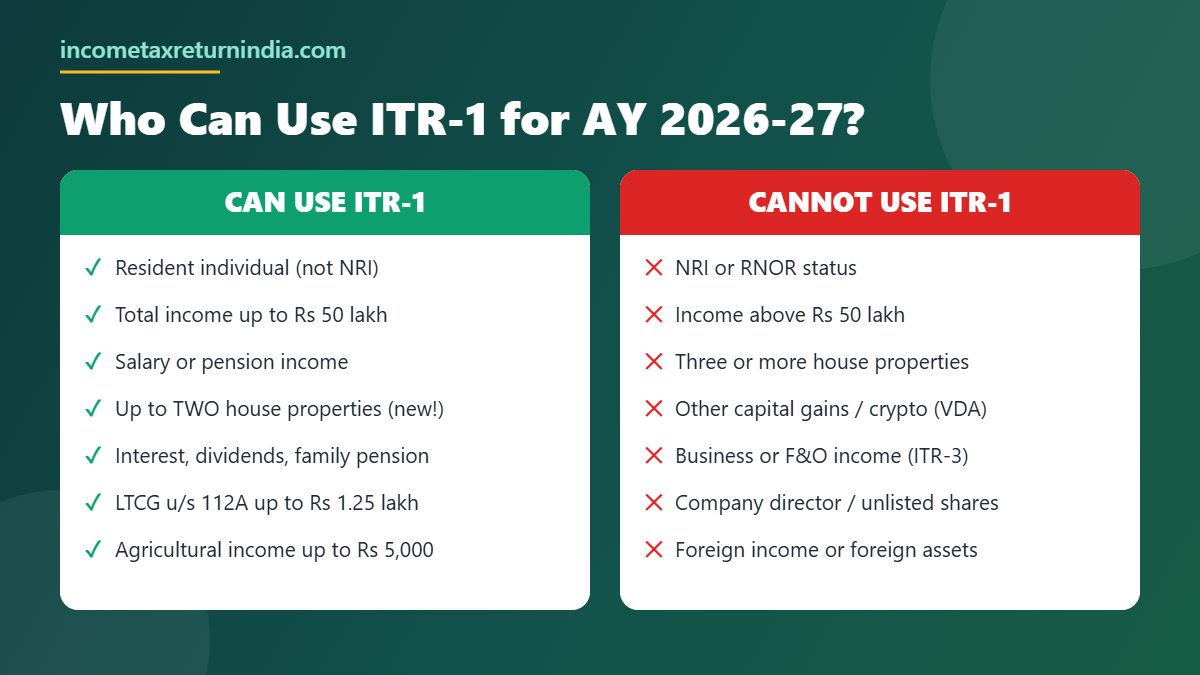
You are eligible if ALL of these apply:
- Resident individual (NRIs and RNORs cannot use ITR-1 – see our NRI tax filing guide)
- Total income up to Rs 50 lakh
- Income from salary or pension
- Income from up to two house properties
- Other sources – bank/FD interest, dividends, family pension
- LTCG under Section 112A up to Rs 1.25 lakh
- Agricultural income up to Rs 5,000
Who cannot use ITR-1?
- Income above Rs 50 lakh – use ITR-2
- Three or more house properties, or house property losses carried forward
- Any capital gains beyond the small 112A window – including crypto/VDA income, which never fits in ITR-1
- Business, professional, F&O or intraday income – that is ITR-3 territory (see our F&O guide), or ITR-4 under presumptive taxation
- Directors of companies or holders of unlisted equity shares
- Foreign assets or foreign income
Documents you need before filing ITR-1
- Form 16 from your employer (both employers if you switched jobs)
- PAN and 12-digit Aadhaar (linked)
- Form 26AS and AIS from the portal – cross-check every TDS entry (our Form 26AS guide shows how)
- Bank account details (pre-validated for refund) and interest certificates
- Home loan interest certificate, rent receipts for HRA, and investment proofs (80C, 80D) if opting for the old regime
- Broker statement if you have small 112A LTCG
Step-by-step: filing ITR-1 online for AY 2026-27
- Log in at incometax.gov.in with PAN. Go to e-File – Income Tax Returns – File Income Tax Return.
- Select AY 2026-27, Online mode, and ITR-1 (Sahaj).
- In Personal Information, verify your details and choose your tax regime – the new regime is default; tick old regime only if your deductions justify it (compare below).
- Check the pre-filled salary data against Form 16 – especially if you changed jobs mid-year (both salaries must appear; duplicate standard deduction is a common portal error).
- Enter house property income – now up to two properties: self-occupied (nil/negative with home-loan interest under Section 24b in the old regime) or let-out (30% standard deduction applies automatically). More detail in our rental income guide.
- Verify interest and dividend income against AIS – the portal pre-fills it; add anything missing (a mismatch here is the top notice trigger for salaried filers).
- Report small 112A LTCG if any, and claim deductions from the new dropdown menus (old regime) – 80C, 80D, 80TTA and so on, with exact clauses.
- Review the computation – confirm the Section 87A rebate has applied if your taxable income is within Rs 12 lakh (new regime). Details in our 87A rebate guide.
- Pay any balance tax via Challan 280, then submit.
- e-Verify within 30 days – Aadhaar OTP is fastest; all methods in our e-verification guide. Then track your refund.
New regime vs old regime in ITR-1
- New regime (default): Rs 75,000 standard deduction + Section 87A rebate = zero tax up to Rs 12.75 lakh for salaried taxpayers. No investment proofs needed. See the full income tax slabs FY 2025-26.
- Old regime: worth it only when your combined deductions – 80C, 80D, HRA, home-loan interest – are large enough to beat the new-regime numbers. Salaried filers can switch regimes every year in ITR-1.
Common ITR-1 mistakes that trigger notices
- Skipping savings/FD interest because TDS was cut or the amount feels small – it is all in your AIS.
- Using ITR-1 when ineligible – crypto gains, big capital gains, F&O income, NRI status or a third property make the return defective under Section 139(9).
- Two Form 16s, one salary reported – job switchers must add both employers.
- Not e-verifying within 30 days – the return is treated as never filed.
- Wrong or non-validated bank account – your refund simply will not arrive.
- Missing 31 July – late fee up to Rs 5,000 under 234F plus interest; see late filing penalties. Belated returns are allowed until 31 December 2026, and ITR-U can fix things later – at a rising cost.
Frequently asked questions – ITR-1
I am a pensioner. Can I use ITR-1?
Yes – pension is taxed as salary, and the Rs 75,000 standard deduction (new regime) applies. Family pension recipients report it under other sources in ITR-1 too.
My income is below the exemption limit. Should I still file?
File anyway if TDS was deducted (refund), if you need proof of income for visas or loans, or if any high-value transactions appear in your AIS.
I changed jobs during FY 2025-26. Which form?
Still ITR-1 – just report both employers’ salaries. Expect a small balance tax if both applied the exemption limit separately.
I sold shares this year. Can I still use ITR-1?
Only if your gains are long-term under Section 112A and total Rs 1.25 lakh or less, with no losses to carry forward. Any short-term gains, or larger LTCG, mean ITR-2.
I have crypto income. ITR-1?
No. Virtual digital asset income always requires ITR-2 (or ITR-3 if traded as business), taxed at a flat 30% under Section 115BBH.
Can I claim HRA and home loan together in ITR-1?
Yes, in the old regime, if you genuinely pay rent in one city while owning a house elsewhere (or your house is under construction). Keep documentation strong – this combination is scrutinised.
Is agricultural income allowed in ITR-1?
Only up to Rs 5,000. Above that, use ITR-2.
What if I make a mistake after filing?
File a revised return up to 31 March 2027 (Budget 2026 extended this from 31 December) – no penalty for genuine corrections.
File your ITR-1 with CA assistance
Send us your Form 16 and we handle the rest – regime comparison, AIS reconciliation, filing and e-verification within 24 hours. Upload your documents or contact CA Rahul Gupta’s team.
Related guides
- How to file ITR for salaried individuals – complete guide
- Who should use ITR-2 – eligibility
- How to file ITR-3 for F&O trading
- Income tax slabs FY 2025-26 – new vs old regime
- Step-by-step e-filing guide
Disclaimer: This guide reflects the ITR-1 requirements for FY 2025-26 (AY 2026-27) under the Income-tax Act, 1961, as understood in July 2026. Rules and utilities change – consult a qualified Chartered Accountant for advice on your specific case.