e-Filing your income tax return for FY 2025-26 (AY 2026-27) takes less than an hour if you prepare properly – and this guide walks you through the entire process: who must file, which ITR form fits your income, the new staggered deadlines, a step-by-step portal walkthrough, and what happens after you press submit. Whether you are salaried, a professional, a trader or an NRI, this is your starting point.
Watch: ITR-1 (Sahaj) Explained in 2 Minutes
File Your Income Tax Return With Us
Step 1: Choose your plan below and pay online. Step 2: Upload your Form 16 & details or email info@incometaxreturnindia.com. Our Chartered Accountants file your return within 24 hours.
Prices are for salaried individuals. Complex cases (business, F&O, NRI) may be quoted separately. All plans include CA-verified filing.
Watch: File ITR-1 in 5 Minutes – Step by Step
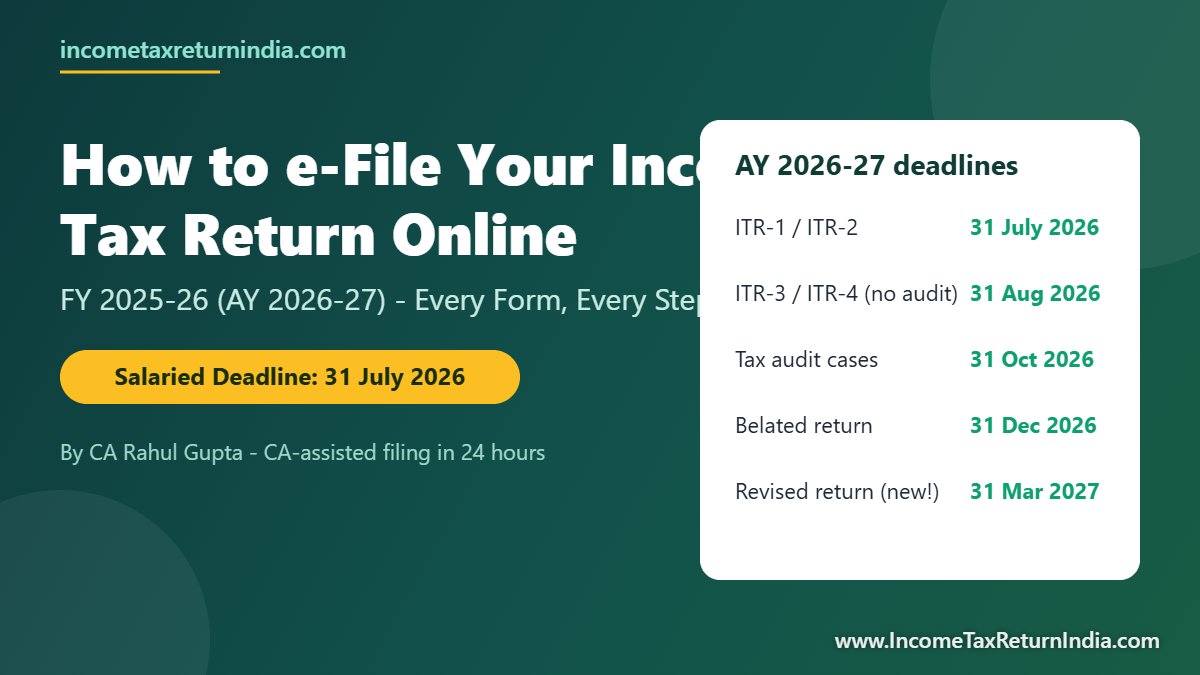
Quick answer: Log in at incometax.gov.in, pick AY 2026-27 and your ITR form, verify the pre-filled data against Form 26AS/AIS, choose your regime, pay any balance tax, submit and e-verify within 30 days. Deadlines: 31 July 2026 (ITR-1/2), 31 August 2026 (ITR-3/4 non-audit), 31 October 2026 (audit cases). Don’t expect an extension – the utilities were released early this year.
Who must file an ITR for FY 2025-26?
- Gross total income above the basic exemption limit – Rs 4 lakh (new regime) or Rs 2.5 lakh (old regime);
- Regardless of income: if you deposited over Rs 1 crore in current accounts, spent over Rs 2 lakh on foreign travel or over Rs 1 lakh on electricity, have foreign assets, or TDS/TCS of Rs 25,000+ was deducted;
- Even when not mandatory, file to claim TDS refunds, carry forward losses, and build income proof for loans and visas.
Step 1: Pick the right ITR form
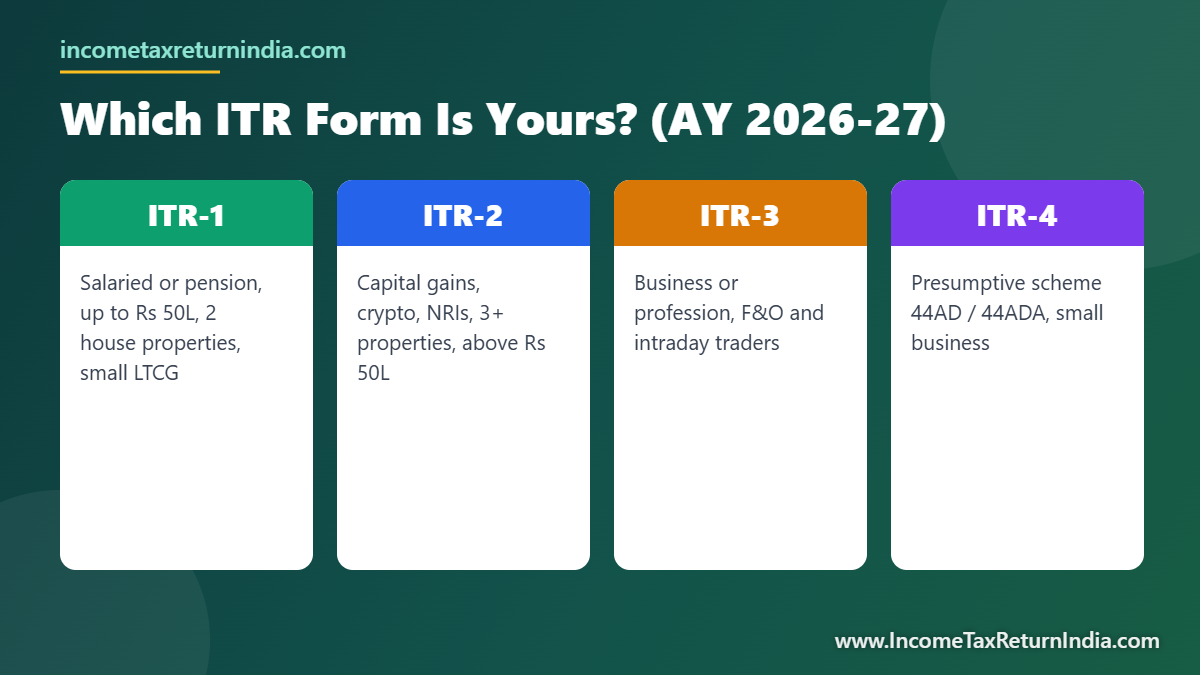
The wrong form makes your return defective under Section 139(9), so start here:
- ITR-1 (Sahaj): resident, salary/pension, income up to Rs 50 lakh, now up to two house properties and equity LTCG up to Rs 1.25 lakh – full details in our ITR-1 eligibility guide and our salaried filing guide;
- ITR-2: capital gains beyond the ITR-1 window, crypto/VDA income, more than two properties, income above Rs 50 lakh, directors, and NRIs – see who should use ITR-2;
- ITR-3: any business or professional income, including F&O and intraday trading (step-by-step guide);
- ITR-4 (Sugam): presumptive taxation under 44AD/44ADA – popular with freelancers and consultants.
Step 2: Know your deadline (they are staggered now)
| Category | Due date |
|---|---|
| ITR-1 / ITR-2 (salaried, pensioners, capital gains) | 31 July 2026 |
| ITR-3 / ITR-4 without audit (business, professionals, traders) | 31 August 2026 |
| Tax audit cases (Section 44AB) | 31 October 2026 |
| Belated return (late fee applies) | 31 December 2026 |
| Revised return – extended by Budget 2026 | 31 March 2027 |
Miss your date and you face a late fee up to Rs 5,000 plus interest – and you permanently lose loss carry-forward. Details: late filing penalty and interest guide.
Step 3: Prepare your documents
- Form 16 / 16A – salary and TDS certificates (all employers if you switched jobs);
- Form 26AS and AIS – the department’s record of your income; every ITR must reconcile with these. Our Form 26AS guide shows how to download and read them;
- Bank interest certificates, broker capital-gains statements, rent receipts, home-loan certificate;
- Investment proofs for the old regime – 80C, 80D, HRA;
- A pre-validated bank account on the portal – refunds are paid only there.
Step 4: File on the portal – the walkthrough
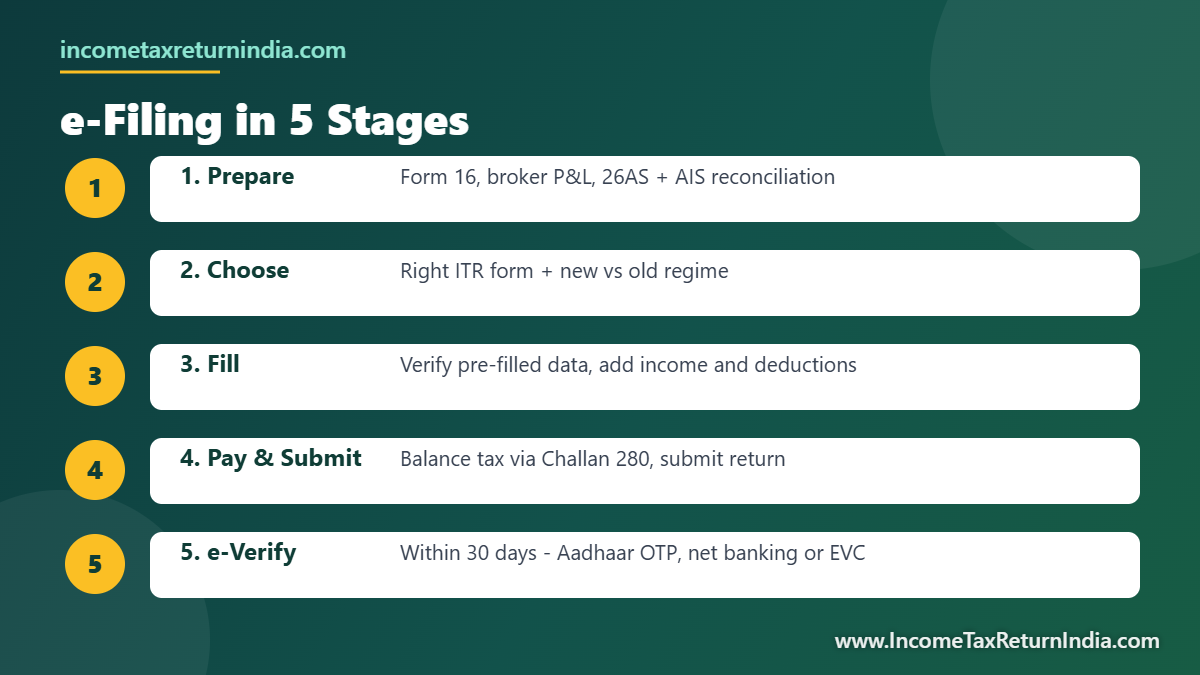
- Log in at incometax.gov.in with PAN (link Aadhaar first if not done – mandatory for residents).
- Go to e-File, then Income Tax Returns, then File Income Tax Return. Select AY 2026-27, Online mode, and your form.
- In Personal Information, confirm your details, residential status and tax regime. The new regime is default; the old regime needs a conscious opt-in (and Form 10-IEA if you have business income).
- Walk through each income schedule – the portal pre-fills salary, interest, dividends and even capital gains from AIS. Verify every figure; pre-fill is a starting point, not gospel. Job switchers: confirm both employers appear.
- Claim deductions – now selected from dropdown menus with exact clauses (old regime), or continue with the new regime’s Rs 75,000 standard deduction and Section 87A rebate (zero tax up to Rs 12 lakh).
- Review the computation. Compare regimes using our income tax slabs guide and new tax regime explainer.
- Pay any balance via Challan 280 (e-Pay Tax) and enter the challan details.
- Submit, then e-verify within 30 days – Aadhaar OTP, net banking, bank/demat EVC or DSC. An unverified return is treated as never filed. All methods: e-verification guide.
After filing: what to expect
- Intimation under Section 143(1) – usually within a few weeks; it confirms your computation or flags mismatches;
- Refund – credited to your pre-validated account, typically 2-5 weeks after verification; track refund status here;
- Made a mistake? File a revised return – now allowed up to 31 March 2027 (extended from 31 December by Budget 2026);
- Missed everything? ITR-U lets you file an updated return for up to 4 years, with additional tax of 25-70%.
Common e-filing mistakes to avoid
- Filing from Form 16 alone without reconciling AIS/26AS – the top cause of notices;
- Choosing the wrong form (F&O in ITR-1/2, crypto in ITR-1, NRI using ITR-1);
- Forgetting savings/FD interest and dividends;
- Not pre-validating the refund bank account;
- Submitting but never e-verifying;
- Waiting for a deadline extension that is not coming.
Frequently asked questions
Can I file my ITR myself or should I use a CA?
A clean single-Form-16 return is very doable yourself. Multiple income sources, trading, property sales, NRI status or notices are where a CA pays for itself – usually by finding a bigger refund or preventing a defective return.
What does e-filing cost?
The government portal is free. Our CA-assisted filing starts at a nominal fee with a 24-hour turnaround – see plans.
Which regime should I pick?
New regime wins for most people with income up to Rs 12.75 lakh (zero tax) or few deductions. Old regime wins with heavy 80C + HRA + home-loan combinations. Salaried filers can switch every year.
The portal is slow near the deadline. Any tips?
File in the morning hours, and do not wait for the last week of July – portal load peaks then, and so do CA queues.
I received an intimation with a demand. What now?
Compare the 143(1) computation column-by-column with your return, pay if genuinely due, or file a rectification/revised return if the department’s data is wrong. We handle rectifications too.
Can I still file for earlier years?
Yes – via ITR-U (updated return) for up to 4 prior years, with graded additional tax. Better late with ITR-U than a non-filing notice.
File with CA Rahul Gupta’s team – 24-hour turnaround
Send your documents, and we choose the right form, compare both regimes, reconcile AIS, file and e-verify – all within 24 hours. Upload your documents or contact us.
Guides by taxpayer type
- Salaried individuals – ITR filing guide
- ITR-1 (Sahaj) – eligibility and new rules
- Freelancers and consultants
- F&O traders – ITR-3 step by step
- NRIs – complete filing guide
Disclaimer: This guide reflects the law for FY 2025-26 (AY 2026-27) under the Income-tax Act, 1961, including Finance Act 2026 changes, as understood in July 2026. Consult a qualified Chartered Accountant for advice on your specific case.