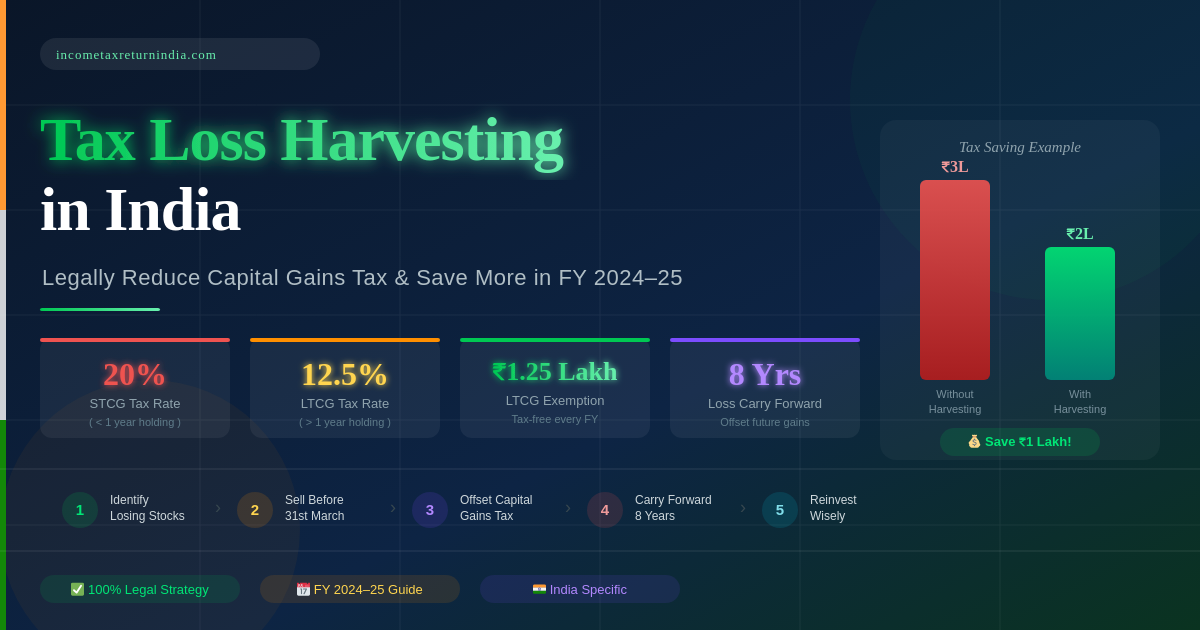
Tax Loss Harvesting in India:
Legally Reduce Capital Gains Tax in FY 2024-25
Most Indian investors unknowingly overpay taxes each year. Tax loss harvesting is a simple, 100% legal strategy that lets you use your portfolio’s underperformers to offset gains- saving you thousands (or lakhs) in capital gains tax before 31st March.
What is Tax Loss Harvesting?
Tax loss harvesting is an investment strategy where you deliberately sell securities that have declined in value to realize a capital loss. You then use that loss to offset capital gains earned elsewhere in your portfolio- directly reducing the amount of tax you owe.
The key insight is that losses are not just setbacks; they are tax assets. Every unrealized loss sitting in your portfolio is money you can legally claim back from the taxman- as long as you act before 31st March of the financial year.
Tax loss harvesting is explicitly permitted under the Income Tax Act, 1961. Under Section 70 and Section 74, capital losses can be set off against capital gains and carried forward for up to 8 assessment years.
Capital Gains Tax Rates in India (FY 2024-25)
Before understanding how harvesting works, you need to know what you’re saving against. India has two types of capital gains tax on equity investments:
The LTCG tax rate was revised upward from 10% to 12.5% in Budget 2024, effective 23 July 2024. The tax-free exemption limit was simultaneously raised from Rs.1 lakh to Rs.1.25 lakh. Indexation benefit was removed for equity assets.
The higher STCG rate of 20% means that short-term gains are far more expensive- making them the primary target for tax loss harvesting. Offsetting even Rs.5 lakh of STCG with losses saves you Rs.1 lakh in tax immediately.
How Tax Loss Harvesting Works- Step by Step
Here is the complete process, broken down into five actionable steps you can follow every financial year:
Identify Loss-Making Investments
Review your portfolio and list all stocks or mutual funds currently trading below your purchase price (cost basis). These unrealized losses are your raw material for harvesting.
Sell Before 31st March
Execute the sell orders before the financial year ends. Only realized losses (from completed sales) can be offset. Unrealized losses sitting in your demat account have no tax value until you sell.
Offset Capital Gains Strategically
Apply realized losses against your gains in order of priority: first offset STCG (taxed at the higher 20% rate), then LTCG above the Rs.1.25 lakh exemption threshold. Short-term losses can offset both STCG and LTCG; long-term losses can only offset LTCG.
Carry Forward Any Remaining Losses
If your losses exceed this year’s gains, you don’t lose the benefit. Under Section 74 of the Income Tax Act, excess capital losses can be carried forward for up to 8 assessment years to offset future gains- provided you file your ITR on time.
Reinvest Wisely (Avoid Wash Sales)
After selling the loss-making asset, reinvest in a similar but not identical stock or fund to maintain your market exposure. Buying the exact same security immediately after selling may attract scrutiny and negate the tax benefit. Opt for a fund in the same category or a comparable stock in the same sector.
Real-World Example: How Much Can You Save?
Let’s walk through a concrete scenario to show the rupee impact of tax loss harvesting.
Investor Scenario- FY 2024-25
An investor has realized Rs.15 lakh in STCG from stock sales, and also holds Rs.5 lakh in unrealized losses from underperforming stocks.
That’s Rs.1 lakh back in your pocket- just by selling underperformers before 31st March
No problem. If your Rs.5 lakh loss exceeds your gains in the current FY, the remaining loss is carried forward for up to 8 years. It will automatically reduce your tax liability when you book profits in future years.
Pro Tips to Maximize Tax Savings
-
Start planning in January, not March. Waiting until the last week of March is the most common mistake. Markets may move against you, reducing available losses. Review your portfolio at least 6-8 weeks before year-end.
-
Use the Rs.1.25 lakh LTCG exemption every year. Even if you have no losses, sell long-term equity holdings with gains up to Rs.1.25 lakh annually. Reinvest immediately to reset your cost basis. Over 10-15 years, this compounds into substantial tax savings.
-
Switch mutual funds within the same category. You can harvest a loss by switching from one large-cap fund to another. This resets your cost basis while keeping your asset allocation intact- a powerful technique for mutual fund investors.
-
Always file your ITR to claim carry-forward. If you incur a capital loss but don’t file your ITR before the due date, you lose the right to carry that loss forward. This is a costly but easily avoidable mistake.
-
Prioritize offsetting STCG first. Since STCG is taxed at 20% vs. LTCG at 12.5%, offsetting short-term gains gives you a bigger tax bang per rupee of loss. Always apply losses to STCG first.
Advanced Strategy: The LTCG Exemption Compounding Hack
This strategy is used by experienced investors to systematically reduce their future tax liability- year after year.
Since LTCG up to Rs.1.25 lakh is completely tax-free, the smart approach is to deliberately crystallize gains up to this limit every year, then immediately reinvest in the same stock or fund at the new (higher) price.
Suppose you hold a stock worth Rs.5 lakh that you bought for Rs.2 lakh (Rs.3 lakh gain). Sell enough units each year to realize Rs.1.25 lakh in gains- tax-free. Reinvest the proceeds immediately. Your cost basis is now higher, meaning your future taxable gain is permanently reduced. Repeat every FY. Over 10 years, the compounding effect on your tax savings is dramatic.
Combined with tax loss harvesting on the losing side, this dual strategy- harvesting losses to offset gains and crystallizing tax-free gains to reset your cost basis– represents the gold standard of tax-efficient investing in India.
Common Mistakes That Can Cost You Money
Mistake 1: Buying Back the Same Security Immediately
If you sell a stock at a loss and repurchase the exact same stock within a very short time, tax authorities may view the transaction as lacking substance. Always wait a reasonable period or switch to a similar security from a different company.
Mistake 2: Failing to Report Losses in Your ITR
Even if your total income is below the taxable limit, you must file an ITR to claim and carry forward capital losses. Skipping the filing permanently extinguishes the loss for carry-forward purposes.
Mistake 3: Forgetting the Rs.1.25 Lakh LTCG Exemption
Hundreds of thousands of investors pay LTCG tax when they didn’t need to. Check your long-term gains each year; the first Rs.1.25 lakh is yours to keep, tax-free. Don’t leave it on the table.
Mistake 4: Selling Just to Save Tax- Without a Reinvestment Plan
Harvesting a loss that leaves you out of the market during a sharp rally can cost you more in missed gains than you saved in taxes. Always have a reinvestment plan ready before executing the sale.
Mistake 5: Ignoring Transaction Costs
Brokerage fees, STT, and exit loads on mutual funds can eat into your tax savings. Make sure the net benefit (tax saved minus transaction costs) is positive before proceeding.
Frequently Asked Questions
Can short-term capital losses be offset against long-term capital gains?
Yes. Under the Indian Income Tax Act, short-term capital losses can be set off against both short-term and long-term capital gains. However, long-term capital losses can only be offset against long-term capital gains.
Does tax loss harvesting apply to debt mutual funds?
Yes. After the 2023 amendment, gains from debt mutual funds are treated as short-term capital gains and taxed at slab rates regardless of holding period. You can still harvest losses from debt funds to offset other capital gains.
What is the last date for tax loss harvesting in FY 2024-25?
The last date is 31st March 2025. Your sell transaction must be executed and settled on or before this date for the loss to count in FY 2024-25.
Can I carry forward losses if I file my ITR after the due date?
No. If you file a belated ITR (after the due date under Section 139(1)), you lose the right to carry forward capital losses to future years. Filing on time is critical to preserve this benefit.
Is there a wash sale rule in India like in the US?
India does not have an explicit statutory wash sale rule equivalent to the US rule. However, transactions that are clearly without commercial substance can potentially be scrutinized under the General Anti-Avoidance Rules (GAAR). As a practical matter, waiting a few days before repurchasing the same security is considered prudent.
Does tax loss harvesting apply to intraday trading losses?
Intraday trading is classified as speculative business income– not capital gains- under Indian tax law. These losses have different set-off rules and can only be offset against speculative business profits, not capital gains.
Trading F&O or intraday? Read our step-by-step ITR-3 filing guide for F&O traders (FY 2025-26) – turnover calculation, tax audit rules and loss carry-forward.